I can't guarantee this post is going to wrap-up very neatly. In fact, as I type this I have absolutely no idea where it's going. What I do know is that it concerns an important topic that has bedevilled me - and those around me - since I got here. And for me will continue to do so long after I leave.
Probably the best place to start is with this picture:
A few days ago, I sent this picture, which I had taken on the coast highway (and travelling fast), to a group of friends and family. I wanted to illustrate a common sight, which I'd mentioned previously, and even discussed in one of my blog posts. I could take a hundred such photos in a day, from any street corner in Beirut. I received a variety of responses, ranging generally from shock to disbelief. These mirrored my own reactions pretty well. I'd taken the photo (and mentioned this type of behavior) in the first place because I find it shocking and very disturbing. The responses I received fit quite well with my presumptions and gave me that feeling of validation that comes from what one might call 'cultural confirmation'.
There were two outliers. Once came from Pam, who has a long and intimate experience in the Mideast (including, but not limited to, the 5 years we lived together here in the 70s). She said: 'one would develop a certain sense of destiny living in these times'. This comment put her into a category by herself as far as responses from outside were concerned.
The other quite different response was from May, who was actually with me when I took the photo. May found the whole exercise very problematic and felt it was an example of something she and I have had numerous discussions about: Western perceptions of the East (and vice versa). This problem has many dimensions, but insofar as it concerns the photo what bothered her was the easy sense of superiority that accompanies this kind of cultural transposition. She asked me a trenchant question: do you in the West have no unexamined behaviors that might endanger your children? She asked a second question: have you stopped to think why this behavior might exist? What it might be about the content of people's lives that would produce it?
I've been mulling this over for the last couple of days, without much success at achieving clarity. May's point is very obviously true. With regard to the Arab world it has very deep ties to European colonialism and US imperialism. Academically, a whole school of thought spawned by Edward Said is concerned with this issue.
The larger problem is how difficult it is to effectively analyze one's own assumptions, predispositions and other cultural baggage. Most of this stuff is unconscious or, at best, very elusive. Because it forms the bedrock of our personalities it intercedes even when trying to think about it, creating a kind of negative feedback loop that can contaminate the very process of examination. This probably has a lot to do with why decades of anthropological controversy surround questions of this sort.
Parenthetically, if the cultural baggage of the observer is an issue in the process of observation then it's also true to say that culture is a determinant on the other side of the equation, as well. The motorcylist with his tiny child clinging to the handlebars is also operating from unexamined cultural norms and behaviors.
Is anthropology even possible? In what sense is it valuable? Is its value always contextual or is there a 'higher level' where the study of human behavior can illuminate something more absolute?
A few mornings ago I ran across an article, Anthropology's Orient, by Palestinian anthropologist Lila Abu Lughod, whom I knew briefly here in Beirut almost 40 years ago. In it she describes some of the 'meta-interactions' she had with a group of Egyptian Bedouin she had been researching. By 'meta-interaction' I mean discussions she had with them about her study of them, and its value and importance. I'm sure that as the world gets smaller and anthropological subjects of study become ever more aware of the outside world, of history and of their place in it, these meta-interactions must become ever more important to the process.
In her article Abu Lughod raises some questions that are related to my mullings over the motorcycle photo and my visit to Lebanon generally. She brings up Edward Said's seminal critique of Orientalism, which forever changed the nature and the practice of 'oriental' studies.
Said's thesis rested in part upon the idea that the practice of Oriental studies was inevitably imbued with and tainted by the legacy of colonialism and by deep-seated ideas of the exoticism of the East. This made it impossible to fairly carry out a study of the East within a Western context - which, in this connection, meant by Westerners in general. Said singled out Bernard Lewis, at the time considered the dean of Oriental studies, for particular criticism. And one could argue that Lewis, who is still active, went on to prove Said's point when, after 9/11, he became a leading voice in the 'clash of civilizations' camp.
Nevertheless, Bernard Lewis and many others in the tradition to which he belongs are not so easily brushed aside. During Lewis' heyday Orientalism was a thriving and distinguished field. Its practitioners, often English, had mastery of multiple languages often stretching back millennia. Individually and collectively they represented a vast storehouse of knowledge about their subjects of study, having read and absorbed primary and secondary materials on every facet of their speciality. Many had lived for long periods within the cultures they studied.
Although the field of Orientalism would normally include India, China and Southeast Asia, the Arab and Islamic world were clear favorites. This was the ground upon which Said attacked, and questioned their ability to carry out any form of balanced study. Said's particular focus was Palestine, and he felt that the problems brought up by his critique were particularly evident with relation to Palestine. Again, it's hard at this point to raise a coherent rebuttal to Said's argument. With the perspective of 65 years it seems self-evident - at least to me - that Said was entirely right in asserting that Orientalism utterly failed in Palestine, at least to the degree that it was unable to counter the prevailing myths that ultimately won public opinion to the Israeli version of events.
But was this entirely because the field is rotten at the core? That Orientalism as a pursuit represents a contradiction and an impossibility?
Lila Abu Lughod's article points out that Said's critique can be broadened to the study of anthropology, generally. The same factors are at play. Since every human being carries his or her cultural context into every aspect of life, the study of other cultures is NEVER possible in a vacuum.
But does that make it valueless or inherently wrong-headed? The problem can be broadened even further by asking: can or should anthropological study be carried out by members of the culture under study? What additional strengths or weaknesses result? Abu Lughod alludes to the problem in a very eloquent passage about cultural clues and understandings: is the movement of an eyelid a simple tic, or is it a wink? The observer needs to be very close to his subject's context in order to understand nuance and motivation. A western anthropologist arriving fresh in Beirut and watching interactions would very likely be mystified: why do people seem to be disagreeing when they should be agreeing, and vice versa? Things as simple as winks, head nods and shakes, shrugs and other even tinier gestures carry crucial information.
On the other hand, even though understanding is crucial, if the observer shares the subject's complete context how can any distance be achieved? If everything makes perfect sense, then critical evaluation becomes difficult, to say the least. And critical evaluation is an essential component in illuminating understandings, motivations, behaviors and their consequences.
To return schematically to my original point: if West studies East or East studies West misunderstandings and worse, a temptation to stigmatize, are perennial problems. But if West studies West or East studies East uncritical acceptance and the lack of a larger context present problems, as well.
The Bernard Lewis' of yesteryear tried very hard to bridge this gap. By immersing themselves in the culture, language and history of their subjects they tried to open a door of understanding without, however, entering and becoming one with their subjects. One wonders if a better method can even exist. Said's criticisms, valid as they are, could also be applied to Chinese anthropologists studying the Arab world, or Arabs studying US culture. And, in fact, a brief survey of Youtube shows an endless number of occasionally hilarious, occasionally horrific misunderstandings of Western history and culture by any number of Arab commentators, professors, immams, and so on. And almost without exception, the intent of these misunderstandings is to bolster a view of the superiority of Arab culture to all others. For the most part, these persons are not anthropologists. But they play an important and somewhat analogous role in mediating and translating understandings of foreign cultures to their own societies.
So, with all that said, what about the photo and the issue it raised? After thinking about this problem almost non-stop for three months, the result - other than a bad headache - is the following: everybody is partly right. This isn't the cop-out it sounds like, and I'll try to explain why.
I've come to the conclusion that pure evaluation of cultural phenomena is impossible because no one is without culture. And even if such an observer existed, being without culture is still one of the manifestations of culture, so it wouldn't constitute a higher point of view. There's no 'meta-view'. At least not among the inhabitants of this planet. In addition, behavior is relativistic. Its meaning and importance are never exactly the same in different contexts. Trying to find absolutes requires looking at a different level entirely. And this level is very difficult to find, to bring into focus or to enunciate in a culturally-neutral way.
Those absolutes are in fact very much in contest right now, because they inevitably clash with cultural norms more or less everywhere. A comparison of the International Declaration of Human Rights and the Cairo Declaration of Human Rights shows this quite clearly. I'm not picking on the Muslim world here. A 'Delhi Declaration' - were one to exist, and were it to be based on Hindu cultural norms - would have to find a way to work the caste system into its schema. And a 'Chicago Declaration' that included cultural/economic norms prevalent in the US would need to shoehorn in acceptance of a system that can throw millions out of their homes (recall that 'shelter' is one of the basic human rights in the International Declaration) while enriching a tiny few through their misfortune.
Nevertheless, the rights of the child and the obligations of parenthood are some of the most deeply felt and widely shared notions we have. They are as close to 'human culture' as anything can be.
Which explains why everybody's reaction to the photo is valid. Those who were shocked were reacting to a failure of the bond between parent and child insofar as it involves protection from physical harm. This bond transcends culture, though its expression may be mediated by culture. The fact that they might have unexamined behaviors of their own that also fail that bond doesn't disqualify their observation; it only means that indulging in a sense of superiority without careful study would be rather hasty.
In this schema Pam gets to play the role of Bernard Lewis (sorry, Pam!). Her open door into the understandings and imperatives of life in Lebanon lead her to a very straightforward statement of context and motivation. She 'gets it', which is not the same thing as saying she would do it herself.
May's reaction is the most rooted in history, in the political and social relations between Western and Eastern cultures, and in the legacy of colonialism. My little exercise was indeed problematic because it stooped to the level of millions of Western tourists snapping photos of the natives all over the world and sending them back home with the implied or stated caption: look what these crazy people do! While revealing a truth, it fed cultural stereotypes and easy assumptions, and invited viewers to indulge in feelings of superiority.
How does one avoid that trap? I frankly don't know. More mulling is in store. At the moment, I'm in Athens, and going through another cultural re-orientation. This one is much easier. In fact, it's so easy it's worrying. Something tells me my unexamined assumptions are having a field-day, but I'm at a complete loss how to deal effectively with that. All I do know is that I made an error in the last paragraph; instead of 'Western tourists' I could have said 'Chinese tourists' or 'Japanese tourists' or even 'Arab tourists'. We all do this, all the time. We judge others according to our understandings and they do the same to us. So, at least, there's something like a new balance developing, as compared to the days when Orientalism, anthropololgy and even stupid old tourism were essentially Western phenomena.
Saturday, October 5, 2013
Friday, September 27, 2013
al Awda - the Return
It's been so busy lately I haven't gotten around to posting on the topic I've most wanted to discuss - the Palestinian experience in Lebanon. And there are at least half a dozen other topics I haven't had time to address!
And today, with an internet connection that resembles an old 14 baud modem, with electricity going down continually, and with people coming for dinner soon and actually expecting some food, is still not that day.
Nevertheless, I'll spend a few moments on Palestine, although not on the topic I mentioned above.
A few days ago I had a fascinating interview with Dr Bayan al Hout. Dr al Hout is a well-known expert on Palestinian affairs who, among many other works, authored a (if not the) definitive investigatory work into the 1982 Sabra and Chatilla massacres. As a someone who experienced the dispossession of 1948 directly and as the wife of PLO co-founder, the late Shafiq al Hout, her experience of Palestinian affairs and Palestinian history is profound and very personal.
A couple of years ago Dr al Hout wrote an article which appeared in the Jerusalem Quarterly, "Evenings in Upper Baq’a: Remembering Ajaj Nuwayhed and Home". In this memoir, she describes her life as a child in Jerusalem and the events of 1948 and their aftermath. I found the article personally moving and very evocative of both the period and the events it discusses. In it, she paints a nuanced picture of the desire for return and its problems and contradictions. At the same time, she evokes a sense of loss that anyone can understand.
She also discusses the looting and decimation of her father's cherished library. Events of this kind, multiplied by the tens of thousands, constituted the very substance of the expulsion of the Palestinians from their homeland. They have been widely discussed and documented even by Israeli historians, never mind Palestinians. Yet they are so little known, even now, in the US that I thought it might be of interest to present Dr al Hout's personal account here as an example. With her permission, here are some passages from her article, starting with what happened to their house after the family left, thinking they would be returning within a few days or weeks at most:
Sitt Emily reported that they – the Israelis – were at first unable to open the door to our house (it was an indestructible solid iron door standing half-way up the staircase leading to the first floor). But they soon brought tall ladders they used to climb up to the large balcony, and managed to open the balcony door. Sitt Emily described her amazement at the Israelis’ persistence in entering the house in this manner: how could they inhabit a house accessible only by ladders? Then she went on to say that the reason for their behavior soon became apparent when a big, empty truck pulled up in front of the house, and she saw a large number of young men working together: some would toss down books from the balcony into the garden below, others gathered them in piles, while yet others would carry them to the truck, where the last group would stack them up. They worked tirelessly for several hours until they had looted the entire library. The Jewish family who seized and occupied the house later told her that they had found the bookcases completely empty.
And here is Dr al Hout's discussion of the question of return (I should mention that both Bayan and Shafiq al Hout were advocates of a single, democratic state in Palestine for Muslims, Jews and Christians. After years of collaboration with Yasir Arafat, Shafiq al Hout broke with him over the Oslo Accords and the decision to pursue a two-state solution in Palestine.):
What interests me is the issue that robs an entire nation of its sleep, the question of return. Some think that return means no more than going back to a house, farm, or orchard passed down from father to son. What manner of return would this be when Israel has transformed every one of Palestine’s landmarks and topographical features? It has destroyed entire villages, wiped out the names of cities, ripped up streets and torn down buildings at will, and plundered the contents of houses before seizing the houses themselves?
What would such a return be like?
I wonder at such a question, and pose another of my own: when did we ever truly leave our country, to be able to talk of returning to it? Does not our country live in our hearts day and night? Is it not with us? Who says that the homeland is no more than a house, or stones, or a title deed, the kind of document we call “koushan” in Palestine?
(...)
I once asked my brother, if he were ever able to return to our house, found it just as we left it, and was allowed to bring back one thing only, what would he take? “The photo albums,” he promptly answered. I put the same question to my father, who answered with regret, “I’d bring the correspondence I had with my friends.” “What if you weren’t able to carry it all?” I asked. “I’d start with the letters from Emir Shakib Arslan.”
Were I to ask myself this question I would say I would come back with the painting of Khaled ibn al-Walid. I admit that I have no wish other than to visit my home just once, even under the pall of occupation. I know that our garden has changed, that the apricot, pomegranate and elder trees are dead and gone, and that the earth has swallowed the blossoms of the morning glory that would creep up the walls and spread over every bit of garden soil. Recently I saw how a section of the garden was lopped off and turned into a parking lot. I also saw, in pictures and video clips made for me by a friend who is a European diplomat, that my house has a number now. It is No. 19 on Rehov Harakevet, or Railway Street.
Perhaps all this is no more than mere nostalgia – which is no sin. Nor is visiting one’s home. Yet the question remains: what is a home? What does the word mean? Home is the homeland. When Palestine is the homeland it is not so only for its people, but for those who love it, who believe its history, every era of its history with no exception, and place their trust in its heritage, its Aqsa Mosque and its Church of the Resurrection.
And today, with an internet connection that resembles an old 14 baud modem, with electricity going down continually, and with people coming for dinner soon and actually expecting some food, is still not that day.
Nevertheless, I'll spend a few moments on Palestine, although not on the topic I mentioned above.
A few days ago I had a fascinating interview with Dr Bayan al Hout. Dr al Hout is a well-known expert on Palestinian affairs who, among many other works, authored a (if not the) definitive investigatory work into the 1982 Sabra and Chatilla massacres. As a someone who experienced the dispossession of 1948 directly and as the wife of PLO co-founder, the late Shafiq al Hout, her experience of Palestinian affairs and Palestinian history is profound and very personal.
A couple of years ago Dr al Hout wrote an article which appeared in the Jerusalem Quarterly, "Evenings in Upper Baq’a: Remembering Ajaj Nuwayhed and Home". In this memoir, she describes her life as a child in Jerusalem and the events of 1948 and their aftermath. I found the article personally moving and very evocative of both the period and the events it discusses. In it, she paints a nuanced picture of the desire for return and its problems and contradictions. At the same time, she evokes a sense of loss that anyone can understand.
She also discusses the looting and decimation of her father's cherished library. Events of this kind, multiplied by the tens of thousands, constituted the very substance of the expulsion of the Palestinians from their homeland. They have been widely discussed and documented even by Israeli historians, never mind Palestinians. Yet they are so little known, even now, in the US that I thought it might be of interest to present Dr al Hout's personal account here as an example. With her permission, here are some passages from her article, starting with what happened to their house after the family left, thinking they would be returning within a few days or weeks at most:
Sitt Emily reported that they – the Israelis – were at first unable to open the door to our house (it was an indestructible solid iron door standing half-way up the staircase leading to the first floor). But they soon brought tall ladders they used to climb up to the large balcony, and managed to open the balcony door. Sitt Emily described her amazement at the Israelis’ persistence in entering the house in this manner: how could they inhabit a house accessible only by ladders? Then she went on to say that the reason for their behavior soon became apparent when a big, empty truck pulled up in front of the house, and she saw a large number of young men working together: some would toss down books from the balcony into the garden below, others gathered them in piles, while yet others would carry them to the truck, where the last group would stack them up. They worked tirelessly for several hours until they had looted the entire library. The Jewish family who seized and occupied the house later told her that they had found the bookcases completely empty.
![]() |
| Khaldoun, the author’s brother, with sister Jinan on the balcony from which the Jewish forces gained access and looted the library. Source: the author's family archives. |
What interests me is the issue that robs an entire nation of its sleep, the question of return. Some think that return means no more than going back to a house, farm, or orchard passed down from father to son. What manner of return would this be when Israel has transformed every one of Palestine’s landmarks and topographical features? It has destroyed entire villages, wiped out the names of cities, ripped up streets and torn down buildings at will, and plundered the contents of houses before seizing the houses themselves?
What would such a return be like?
I wonder at such a question, and pose another of my own: when did we ever truly leave our country, to be able to talk of returning to it? Does not our country live in our hearts day and night? Is it not with us? Who says that the homeland is no more than a house, or stones, or a title deed, the kind of document we call “koushan” in Palestine?
(...)
I once asked my brother, if he were ever able to return to our house, found it just as we left it, and was allowed to bring back one thing only, what would he take? “The photo albums,” he promptly answered. I put the same question to my father, who answered with regret, “I’d bring the correspondence I had with my friends.” “What if you weren’t able to carry it all?” I asked. “I’d start with the letters from Emir Shakib Arslan.”
![]() |
| A view of the house at what is now No. 19, Rehov Harakevet. Source: taken in the late 1990s by a diplomat friend of the author |
Perhaps all this is no more than mere nostalgia – which is no sin. Nor is visiting one’s home. Yet the question remains: what is a home? What does the word mean? Home is the homeland. When Palestine is the homeland it is not so only for its people, but for those who love it, who believe its history, every era of its history with no exception, and place their trust in its heritage, its Aqsa Mosque and its Church of the Resurrection.
Monday, September 23, 2013
Calligraphy again - sign painting as an art form
In previous posts I've talked about the exquisite calligraphy of my late friend, Muhammad Hamady. As well as that of Dr Sami Makarem and his father, the great master calligrapher Sheikh Nassib Makarem.
And when we think of calligraphy we often think of it as a form of fine art, something we might find on the walls of a museum.
But, in fact, in our modern, literate and advertising-saturated world we're surrounded by calligraphy. Wherever one looks on sees signs, words, phrases, logos and other forms of lettering.
Of course, a lot of this clutter doesn't merit the term calligraphy. But quite a bit more than we might realize probably does. We just don't see its true value because of the clutter that surrounds it on every side.
In the Arab world, calligraphy is considered one of the highest of the art forms, due to its relationship with the Quran and with the God who began the universe by creating a pen and commanding it to 'write!".
Over centuries, Arabic has developed a wide variety of scripts, some of which emphasize vertical forms, while others emphasize the horizontal. Some are quite static, others musical in their lyricism and sense of movement.
As you can probably tell, I love Arabic calligraphy.
Fine art calligraphy is a beautiful thing. But there are humbler forms that can also be wonderful in their simplicity and eloquence. Even something as simple as a sign over a shop. Today, as I was arriving back at my apartment, I happened to run into this guy, working on a sign just a couple of doors down. Fortunately, I had my cam with me. If you have 5 minutes or so to spare, here's a guy who shows how a good eye, a steady hand, and lots of experience can produce true art...on a metal door!
BTW, the final product will almost certainly require another color over the white background. (I'll find out tomorrow.) The whole phrase (visible at the end of the clip)? mo'asasat al intishar al arabi. Something like: The Institution for the Spread of Arabic.
Oh, yeah...all the chirping and tweeting comes from the bird shop next door.
And when we think of calligraphy we often think of it as a form of fine art, something we might find on the walls of a museum.
But, in fact, in our modern, literate and advertising-saturated world we're surrounded by calligraphy. Wherever one looks on sees signs, words, phrases, logos and other forms of lettering.
Of course, a lot of this clutter doesn't merit the term calligraphy. But quite a bit more than we might realize probably does. We just don't see its true value because of the clutter that surrounds it on every side.
In the Arab world, calligraphy is considered one of the highest of the art forms, due to its relationship with the Quran and with the God who began the universe by creating a pen and commanding it to 'write!".
Over centuries, Arabic has developed a wide variety of scripts, some of which emphasize vertical forms, while others emphasize the horizontal. Some are quite static, others musical in their lyricism and sense of movement.
As you can probably tell, I love Arabic calligraphy.
Fine art calligraphy is a beautiful thing. But there are humbler forms that can also be wonderful in their simplicity and eloquence. Even something as simple as a sign over a shop. Today, as I was arriving back at my apartment, I happened to run into this guy, working on a sign just a couple of doors down. Fortunately, I had my cam with me. If you have 5 minutes or so to spare, here's a guy who shows how a good eye, a steady hand, and lots of experience can produce true art...on a metal door!
BTW, the final product will almost certainly require another color over the white background. (I'll find out tomorrow.) The whole phrase (visible at the end of the clip)? mo'asasat al intishar al arabi. Something like: The Institution for the Spread of Arabic.
Oh, yeah...all the chirping and tweeting comes from the bird shop next door.
Saturday, September 21, 2013
Sabra & Chatilla; commemorating a massacre
Yesterday I went to the 31st anniversary commemoration of the 1982 massacres at Sabra and Chatilla refugee camp.
31 years! To me it still seems like recent history. For the children who paraded in their school uniforms yesterday it must be no more than a distant event in a long series of such tragedies. Being a Palestinian child in Lebanon is to share a history of massacres, betrayals, defeats and discrimination. Since 1982 an unending series of disasters has befallen the community.
For those who recall barely or not at all, the massacres at Sabra and Chatilla occurred during the 1982 Israeli invasion of Lebanon, at a point where Israeli forces had seized control of the majority of Beirut itself.
Over two days, between the 16th and the 18th of September, right-wing Phalangist militias entered the camps and slaughtered somewhere between 1000 and 4000 people. When the light failed at sunset, they continued the killing under brights lights and flares.
The bodies were left lying where they fell or else bulldozed into shallow mass graves.
Starting the day after, aid workers and journalists began to recount what they discovered upon entering Sabra and Chatilla, and the controversy was immediate. The Phalangists were in open alliance with Israel. Was Israel to blame? What did the Israeli forces know? What did Defense Minister Ariel Sharon know? Was there in fact Israeli collusion in the massacre?

The Israelis, of course, denied any knowledge or involvement.
I was not one of the journalists to visit Sabra and Chatilla in the days following the massacre. I arrived in Beirut and visited Sabra and Chatilla a few weeks later, when the controversy was at its height, commissions of inquiry were being formed, and newspapers all over the world were headlining the issue.
Almost serendipitously, during that trip I was to settle the question of Israeli collusion to my own satisfaction once and for all and to at least help clarify it for my Pacifica audience.
To return for a moment to yesterday's commemoration, I climbed out of the service around 10:30 in the morning to find a parade forming in the main street outside the camp. In a way, it was eerily reminiscent of my kids elementary school days: troops of children in school uniforms holding various musical instruments being herded into formation by teachers, all accompanied by the cacophonous sounds of instruments being tooted, banged and honked in preparation. Flags and banners flew in the sun, kids ran about poking each other and laughing...as I say, it was momentarily and disarmingly like something out of my own children's childhoods.
A few moments later the drums and the bagpipes got going and the parade began to move. The kids headed down the avenue and turned left into Chatilla camp. Everything was quite changed from my recollections, yet I knew from major landmarks that this was the same entrance I'd used in 1982. However, I recalled a large, garbage-strewn expanse at the entrance where most of the bodies had been hastily buried just a couple of weeks before. That expanse was nowhere to be seen.
Another 50 meters or so and the parade took a sharp right turn through an arched gate, and I found my expanse - now walled off and preserved as a commemorative precinct. At the far end, a low marble table surrounded by banners and explanatory posters.
Back in 1982 the low shanties of Chatilla camp surrounded the empty field on three sides. From there, the tiny alleyways common to all Palestinian camps (due to draconian building restrictions imposed by the Lebanese government) wound outwards into the camp proper. To the north, the camp was more or less bounded by the then-ruined stadium and parts of Sabra. To the south lay the avenue the children had just paraded down - although much, much less built-up than today. To the east: Sabra and Horsch. To the west Chatilla was bounded by another large avenue, which appears on current maps with the surreal name Hafiz el Asad Avenue, and which will become important in a moment.
In 1982 I spent about an hour walking the alleyways of Chatilla. Most traces of the killing were gone, of course. Except for the thousands of bullet holes, often concentrated along walls where people had been lined up and shot at close range. What was left was the general destruction of the buildings, the remains of the looting, the missing doors and broken windows. A few survivors remained as well, and even a few children. Meanwhile, on the ground beneath their feet were the broken toys and torn clothing of children who hadn't survived.
Now, 31 years later, children dressed in neat school uniforms paraded and played marching music as we filed into the cemetery. Around them lay a refugee camp rebuilt, but just as stiffling, just as crippling to the spirit, as the camp that had been essentially destroyed by the maurading Phalangists back in '82.
And, next to the marble bier there is another banner commemorating the hundreds of deaths that took place during the 2006 fighting in South Lebanon between Hezb Allah and invading Israeli troops.
It was in this sad place that we came to a halt before the marble bier and the crowd filled in behind us. The music sputtered out and several large wreaths were brought forward and laid on the marble. And then came the most understated, and most affecting part of the ceremony. So understated, in fact, that many people, thinking everything was over, walked off.
I was almost among them. Then I noticed some older people moving forward through the crowd with photos in their arms. They approached the bier and simply placed their photos on it, holding them vertically so they could be seen. And they stood there, silently, stoically, quietly, while those of us with cameras snapped away or took our video footage. 31 years, and the look on their faces was as if it had happened yesterday.
Back in '82, even weeks after the event, being in Chatilla was too much for me. I remember how I stumbled out of the camp feeling short of breath. It wasn't until I got back to the main avenue that I even looked up again. At that moment I noticed a couple of tall buildings just west of the camp, across the large avenue. Looking at them I realized that they essentially overlooked the camp. As I said earlier, the Israelis were at that point denying any knowledge of the killings, while detractors were claiming that they had occupied positions nearby which would have given them the ability to oversee Chatilla. The Israeli response was that their positions were too far away to provide any clear view of the events.
With all this in mind I started walking up the hill towards the avenue and those buildings. At the intersection I ran into an Italian soldier, a member of the peace-keeping force that had been sent in just a little too late, after the massacres had already taken place. Using my non-existent Italian we began chatting, and I explained in gestures that I was planning to visit the nearest of the two tall buildings across the street. For whatever reason, he decided to accompany me and together we crossed the avenue and entered the empty, trashed apartment building. Up we went, checking out the apartments, all of whose doors had been broken down. Almost immediately we ran into the detritus of war, all of it Israeli. Papers of various kinds, nearly all in Hebrew, were everywhere (a few things weren't in Hebrew - they were in English). Shells littered the floors. More papers. An apartment that had apparently been reserved as a toilet for the troops - and I don't mean that they used the bathroom for this purpose. Finally, we made it to the roof. Again, endless amounts of litter, trash, paperwork. I even ran into several large, bound manuals in Hebrew...one of which I kept as a keepsake.
Then we approached the eastern edge of the roof. As I expected, just on the other side of the avenue, there was a low wall. And on the other side of the wall...the alleys of Chatilla camp. I raised my camera, equipped with the longest lens I had with me - a mere 200mm - to my eye. From where I stood I could easily follow the winding alleys I'd just walked in Chatilla, and, at one point, even watch the children I'd just stood beside a few moments earlier, playing in the rubble.
So much for that argument. And, of course, it later transpired that Israeli forces had provided night lighting for the Phalangist executioners and the bulldozers used to destroy the camps, that the IDF troops had been seen by multiple observers at various places directly outside the camps, and that the testimony of camp survivors placed Israeli forces inside the camps with their Phalangist allies. And yet, despite all that and despite a spate of condemnatory international investigations, Israel was largely successful in its effort to whitewash its complicity in the massacres and Ariel Sharon went on to become head of the Likud party and then Prime Minister of Israel.
And it was probably about a year later, at a press conference in Los Angeles, that Sharon said - in response to a question by my co-producer, Sarah Mardell - "I bomb Palestinians in Lebanon and Jordan so that I don't have to bomb them in Bethlehem and Ramallah." Which, of course, Israel then went on to do - and has continued to do ever since.
Here's a video recap of yesterday's commemoration:
31 years! To me it still seems like recent history. For the children who paraded in their school uniforms yesterday it must be no more than a distant event in a long series of such tragedies. Being a Palestinian child in Lebanon is to share a history of massacres, betrayals, defeats and discrimination. Since 1982 an unending series of disasters has befallen the community.
For those who recall barely or not at all, the massacres at Sabra and Chatilla occurred during the 1982 Israeli invasion of Lebanon, at a point where Israeli forces had seized control of the majority of Beirut itself.
The bodies were left lying where they fell or else bulldozed into shallow mass graves.
Starting the day after, aid workers and journalists began to recount what they discovered upon entering Sabra and Chatilla, and the controversy was immediate. The Phalangists were in open alliance with Israel. Was Israel to blame? What did the Israeli forces know? What did Defense Minister Ariel Sharon know? Was there in fact Israeli collusion in the massacre?
The Israelis, of course, denied any knowledge or involvement.
I was not one of the journalists to visit Sabra and Chatilla in the days following the massacre. I arrived in Beirut and visited Sabra and Chatilla a few weeks later, when the controversy was at its height, commissions of inquiry were being formed, and newspapers all over the world were headlining the issue.
Almost serendipitously, during that trip I was to settle the question of Israeli collusion to my own satisfaction once and for all and to at least help clarify it for my Pacifica audience.
To return for a moment to yesterday's commemoration, I climbed out of the service around 10:30 in the morning to find a parade forming in the main street outside the camp. In a way, it was eerily reminiscent of my kids elementary school days: troops of children in school uniforms holding various musical instruments being herded into formation by teachers, all accompanied by the cacophonous sounds of instruments being tooted, banged and honked in preparation. Flags and banners flew in the sun, kids ran about poking each other and laughing...as I say, it was momentarily and disarmingly like something out of my own children's childhoods.
A few moments later the drums and the bagpipes got going and the parade began to move. The kids headed down the avenue and turned left into Chatilla camp. Everything was quite changed from my recollections, yet I knew from major landmarks that this was the same entrance I'd used in 1982. However, I recalled a large, garbage-strewn expanse at the entrance where most of the bodies had been hastily buried just a couple of weeks before. That expanse was nowhere to be seen.
Another 50 meters or so and the parade took a sharp right turn through an arched gate, and I found my expanse - now walled off and preserved as a commemorative precinct. At the far end, a low marble table surrounded by banners and explanatory posters.
Back in 1982 the low shanties of Chatilla camp surrounded the empty field on three sides. From there, the tiny alleyways common to all Palestinian camps (due to draconian building restrictions imposed by the Lebanese government) wound outwards into the camp proper. To the north, the camp was more or less bounded by the then-ruined stadium and parts of Sabra. To the south lay the avenue the children had just paraded down - although much, much less built-up than today. To the east: Sabra and Horsch. To the west Chatilla was bounded by another large avenue, which appears on current maps with the surreal name Hafiz el Asad Avenue, and which will become important in a moment.
In 1982 I spent about an hour walking the alleyways of Chatilla. Most traces of the killing were gone, of course. Except for the thousands of bullet holes, often concentrated along walls where people had been lined up and shot at close range. What was left was the general destruction of the buildings, the remains of the looting, the missing doors and broken windows. A few survivors remained as well, and even a few children. Meanwhile, on the ground beneath their feet were the broken toys and torn clothing of children who hadn't survived.
Now, 31 years later, children dressed in neat school uniforms paraded and played marching music as we filed into the cemetery. Around them lay a refugee camp rebuilt, but just as stiffling, just as crippling to the spirit, as the camp that had been essentially destroyed by the maurading Phalangists back in '82.
And, next to the marble bier there is another banner commemorating the hundreds of deaths that took place during the 2006 fighting in South Lebanon between Hezb Allah and invading Israeli troops.
It was in this sad place that we came to a halt before the marble bier and the crowd filled in behind us. The music sputtered out and several large wreaths were brought forward and laid on the marble. And then came the most understated, and most affecting part of the ceremony. So understated, in fact, that many people, thinking everything was over, walked off.
I was almost among them. Then I noticed some older people moving forward through the crowd with photos in their arms. They approached the bier and simply placed their photos on it, holding them vertically so they could be seen. And they stood there, silently, stoically, quietly, while those of us with cameras snapped away or took our video footage. 31 years, and the look on their faces was as if it had happened yesterday.
Back in '82, even weeks after the event, being in Chatilla was too much for me. I remember how I stumbled out of the camp feeling short of breath. It wasn't until I got back to the main avenue that I even looked up again. At that moment I noticed a couple of tall buildings just west of the camp, across the large avenue. Looking at them I realized that they essentially overlooked the camp. As I said earlier, the Israelis were at that point denying any knowledge of the killings, while detractors were claiming that they had occupied positions nearby which would have given them the ability to oversee Chatilla. The Israeli response was that their positions were too far away to provide any clear view of the events.
Then we approached the eastern edge of the roof. As I expected, just on the other side of the avenue, there was a low wall. And on the other side of the wall...the alleys of Chatilla camp. I raised my camera, equipped with the longest lens I had with me - a mere 200mm - to my eye. From where I stood I could easily follow the winding alleys I'd just walked in Chatilla, and, at one point, even watch the children I'd just stood beside a few moments earlier, playing in the rubble.
![]() |
| Here is a panorama showing the buildings, the avenue, and the wall behind which lies Chatilla camp |
| This photo in Chatilla looks due west. Behind the last buildings is the low wall and the avenue. |
So much for that argument. And, of course, it later transpired that Israeli forces had provided night lighting for the Phalangist executioners and the bulldozers used to destroy the camps, that the IDF troops had been seen by multiple observers at various places directly outside the camps, and that the testimony of camp survivors placed Israeli forces inside the camps with their Phalangist allies. And yet, despite all that and despite a spate of condemnatory international investigations, Israel was largely successful in its effort to whitewash its complicity in the massacres and Ariel Sharon went on to become head of the Likud party and then Prime Minister of Israel.
And it was probably about a year later, at a press conference in Los Angeles, that Sharon said - in response to a question by my co-producer, Sarah Mardell - "I bomb Palestinians in Lebanon and Jordan so that I don't have to bomb them in Bethlehem and Ramallah." Which, of course, Israel then went on to do - and has continued to do ever since.
Here's a video recap of yesterday's commemoration:
Wednesday, September 18, 2013
Woman rescued from stalled elevator. Visiting journalist saves her...but earns her undying enmity
Those of you who've been reading this blog for a while will remember a post I did a few weeks ago about the constant power cuts in Beirut. In that post I speculated what it would be like for someone to be caught in a stalled elevator during a power cut. The other night, I came face-to-face with it.
My friend May had invited me up for dinner and we'd just finished a truly delicious chicken and rice dish that she had made. I was just about to leave, and May was out of cigarettes (May is eternally out of cigarettes!), so we were just leaving her 8th floor apartment together when everything suddenly went pitch black. Time for plan B. We grabbed a couple of tiny keychain flashlights and headed down the dark stairs. A bit like descending into a mine with only two tiny points of light as guidance.
A few floors down we started hearing banging coming from somewhere. Another floor and our tiny lights fell upon a woman and a small boy standing by the elevator. The boy was sobbing, while muffled calls came from the elevator.
It turned out his grandmother was stuck between floors in the elevator.
May went to work calming the boy while I went into problem-solving mode. Meanwhile, other tenants arrived and started milling about in the dark to no particular effect. Then, the wife of the conceirge arrived, bearing a somewhat larger light and an enormous pair of wire cutters. This was apparently the only tool in their possession that might be of help.
So far, things were looking quite unpromising. As I accumulated data, they got worse. First off, the elevator had come to a halt exactly halfway between floors. This meant there was no climbing down to the lower floor because the drop would have been dangerous for a healthy adolescent, let alone an elderly grandmother. On the other hand, climbing out to the upper floor was going to require a ladder or some other aid. If the person was elderly or had disabilities getting the door open might only be the beginning of the solution.
Things got worse. Elevator doors have simple latch locks that can be opened with a pretty basic key in case of emergency. But you have to have the key, and at first it seemed nobody did. Then, suddenly, someone turned up with one. We happened to be on the lower floor at that point and the triangular key exactly matched the door lock. Of course, that wasn't the door we needed to open. We rushed upstairs, only to dicover that somehow that door had a very differently shaped lock!
At this point we were all milling about rather uselessly for a few minutes. We seemed to be completely stymied by someone's incomprehensible decision to use different locks on different floors, not to mention someone else's incomprehensible decision not to supply proper keys to the tenants, for whom this danger is a nightly event!
But 'problem-solving' is my middle name (and a weird one it is)! And, just a few days before I'd done some electrical work in May's apartment to get a ceiling light working again. And at that moment I recalled that I'd seen a pair of pliers among her tools.
The two of us trooped back upstairs in the dark and the humid heat, fished around til May found the pliers, then made our slow way back down.
With the pliers in hand, it was - as P G Wodehouse would have said if he'd been with us - a matter of but a moment to force the lock and open the door. Someone brought a folding chair which we passed down to the trappee. Using that, she was just able to reach high enough to get a grip on us and slowly work herself up and out.
Then I had the worst idea I've had in days, if not hours (I have them quite frequently). The sight of this women fighting to extract herself from a stalled elevator in the dark, illuminated by only a few flashlights, was so striking and so emlematic to me of everything that's crazy about life in Beirut that I grabbed my camera and prepared to take a picture.
What I failed to noice was that she was dressed in her 'housecoat'. Which, for her, might as well have been her underwear. She looked up just as she finally managed to get onto the floor...and saw my camera pointed at her. Even in the dark I could see the look of horror come across her face.
Two days later she was still talking about the foreign journalist who took pictures of her in her pyjamas. Hearing that it was him that had opened the door so she could escape only mollified her partially. To refer again to Wodehouse: she may have been somewhat less disgruntled, but she was very, very far from being gruntled.
Even more ironic: I failed to manipulate the camera quickly enough, because I only had one hand free. Thus, I never got the picture I was trying to get before she looked up. Had I gotten it, her face wouldn't have shown up, anyway. And thus I have no picture to add to this post!
My friend May had invited me up for dinner and we'd just finished a truly delicious chicken and rice dish that she had made. I was just about to leave, and May was out of cigarettes (May is eternally out of cigarettes!), so we were just leaving her 8th floor apartment together when everything suddenly went pitch black. Time for plan B. We grabbed a couple of tiny keychain flashlights and headed down the dark stairs. A bit like descending into a mine with only two tiny points of light as guidance.
A few floors down we started hearing banging coming from somewhere. Another floor and our tiny lights fell upon a woman and a small boy standing by the elevator. The boy was sobbing, while muffled calls came from the elevator.
It turned out his grandmother was stuck between floors in the elevator.
May went to work calming the boy while I went into problem-solving mode. Meanwhile, other tenants arrived and started milling about in the dark to no particular effect. Then, the wife of the conceirge arrived, bearing a somewhat larger light and an enormous pair of wire cutters. This was apparently the only tool in their possession that might be of help.
So far, things were looking quite unpromising. As I accumulated data, they got worse. First off, the elevator had come to a halt exactly halfway between floors. This meant there was no climbing down to the lower floor because the drop would have been dangerous for a healthy adolescent, let alone an elderly grandmother. On the other hand, climbing out to the upper floor was going to require a ladder or some other aid. If the person was elderly or had disabilities getting the door open might only be the beginning of the solution.
Things got worse. Elevator doors have simple latch locks that can be opened with a pretty basic key in case of emergency. But you have to have the key, and at first it seemed nobody did. Then, suddenly, someone turned up with one. We happened to be on the lower floor at that point and the triangular key exactly matched the door lock. Of course, that wasn't the door we needed to open. We rushed upstairs, only to dicover that somehow that door had a very differently shaped lock!
At this point we were all milling about rather uselessly for a few minutes. We seemed to be completely stymied by someone's incomprehensible decision to use different locks on different floors, not to mention someone else's incomprehensible decision not to supply proper keys to the tenants, for whom this danger is a nightly event!
But 'problem-solving' is my middle name (and a weird one it is)! And, just a few days before I'd done some electrical work in May's apartment to get a ceiling light working again. And at that moment I recalled that I'd seen a pair of pliers among her tools.
The two of us trooped back upstairs in the dark and the humid heat, fished around til May found the pliers, then made our slow way back down.
With the pliers in hand, it was - as P G Wodehouse would have said if he'd been with us - a matter of but a moment to force the lock and open the door. Someone brought a folding chair which we passed down to the trappee. Using that, she was just able to reach high enough to get a grip on us and slowly work herself up and out.
Then I had the worst idea I've had in days, if not hours (I have them quite frequently). The sight of this women fighting to extract herself from a stalled elevator in the dark, illuminated by only a few flashlights, was so striking and so emlematic to me of everything that's crazy about life in Beirut that I grabbed my camera and prepared to take a picture.
What I failed to noice was that she was dressed in her 'housecoat'. Which, for her, might as well have been her underwear. She looked up just as she finally managed to get onto the floor...and saw my camera pointed at her. Even in the dark I could see the look of horror come across her face.
Two days later she was still talking about the foreign journalist who took pictures of her in her pyjamas. Hearing that it was him that had opened the door so she could escape only mollified her partially. To refer again to Wodehouse: she may have been somewhat less disgruntled, but she was very, very far from being gruntled.
Even more ironic: I failed to manipulate the camera quickly enough, because I only had one hand free. Thus, I never got the picture I was trying to get before she looked up. Had I gotten it, her face wouldn't have shown up, anyway. And thus I have no picture to add to this post!
Alibis Written in Blood
Once again, a piece from l'Orient le Jour. This time it's an editorial that appeared today, left and above the fold, by writer Issa Ghorayeb.
In the last few days I've had a series of depressing conversations with friends, new acquaintances, even service drivers. The theme has always been the same: the US strikes may not happen, but war is still coming to Lebanon.
The feeling of unfinished business is pervasive, disquieting and very troubling. As if it wasn't troubling enough in itself, there's also an inability to explain exactly why this has to happen, or what will cause it. People shrug their shoulders and smile tiredly. There are too many enemies, too many plots, too many causes, and....no more heroes.
I thought the piece below embodied some of that feeling, as did Walid Joumblatt's piece a few days ago, which I posted last week. This one is more generically about the Arab world as well as Lebanon. It touches on a lot of themes that keep coming up here: cyncial governance, manipulation of public opinion, lack of democracy and education, and something about the Arab world that makes it insist on walking against the current of history.
As we like to say, the creation of Israel was the beginning of all our troubles. Not only does the Palestinian problem continue to haunt us exactly as before, not only have new territories been lost over the decades, but the convulsions of this conflict have generated any number of equally important crises over the years.
But, even so, how to ignore the enormous role played by the Arabs themselves in this frenetic march backwards against the tides of history?
It was supposedly to revenge the debacle of 1948 that corrupt monarchies were overthrown by officers who would soon prove even more despotic. As it was supposedly in order to better counter Israel's formidable war machine - but actually in order to better cement their hold on power - that these dashing, over-dressed revolutionaries made their populations live without bread so they could buy ever more canons.
And it was still in the cause of Palestine that the Palestinian guerillas somehow lost their compass bearings and, rather than taking the road to Jerusalem, ended up mucking about in Beirut and even Jouneh.
We Lebanese still haven't finished rubbing elbows with - and actually embracing - every kind of absurdity, brought to us live and in living color. Right next door a pitiless tyrant uses against his own people chemical weapons that were supposedly aquired to provide a balance of terror against Israel's nuclear arsenal. Caught red-handed, he accepts to give them up - or, at least, pretend to - in order to hold on to his throne which swims in the blood of innocents.
And it's to give a helping hand to this torturer that Hezbollah, under orders from its patron Iran, sends men off to fight in Syria. All the while invoking, without even the suspicion of an ironic smile, the imperative of resisting the Israeli enemy.
Still mouthing this slogan, it continues its guerilla action against the gears and cogs of our own state structures. And seeks to shadow - if not replace - those same state institutions. All the while explaining away its activities by the weakness of those institutions...while it works furiously to weaken them further. The courageous and healthy wave of protests in Zahle over the installation, reparation, or maintenance (who knows which?) of Hezbollah's private telecommunications network served to remind Lebanese of the rampant intrusion of the ever-encroaching spider's web of ears that can spy on everything.
And, of course, always and again in the name of resistance against the enemy.
If that excuse didn't already exist among the ruins of unfortunate Palestine, we'd have to invent it.
In the last few days I've had a series of depressing conversations with friends, new acquaintances, even service drivers. The theme has always been the same: the US strikes may not happen, but war is still coming to Lebanon.
The feeling of unfinished business is pervasive, disquieting and very troubling. As if it wasn't troubling enough in itself, there's also an inability to explain exactly why this has to happen, or what will cause it. People shrug their shoulders and smile tiredly. There are too many enemies, too many plots, too many causes, and....no more heroes.
I thought the piece below embodied some of that feeling, as did Walid Joumblatt's piece a few days ago, which I posted last week. This one is more generically about the Arab world as well as Lebanon. It touches on a lot of themes that keep coming up here: cyncial governance, manipulation of public opinion, lack of democracy and education, and something about the Arab world that makes it insist on walking against the current of history.
Alibi written in blood
But, even so, how to ignore the enormous role played by the Arabs themselves in this frenetic march backwards against the tides of history?
It was supposedly to revenge the debacle of 1948 that corrupt monarchies were overthrown by officers who would soon prove even more despotic. As it was supposedly in order to better counter Israel's formidable war machine - but actually in order to better cement their hold on power - that these dashing, over-dressed revolutionaries made their populations live without bread so they could buy ever more canons.
And it was still in the cause of Palestine that the Palestinian guerillas somehow lost their compass bearings and, rather than taking the road to Jerusalem, ended up mucking about in Beirut and even Jouneh.
We Lebanese still haven't finished rubbing elbows with - and actually embracing - every kind of absurdity, brought to us live and in living color. Right next door a pitiless tyrant uses against his own people chemical weapons that were supposedly aquired to provide a balance of terror against Israel's nuclear arsenal. Caught red-handed, he accepts to give them up - or, at least, pretend to - in order to hold on to his throne which swims in the blood of innocents.
And it's to give a helping hand to this torturer that Hezbollah, under orders from its patron Iran, sends men off to fight in Syria. All the while invoking, without even the suspicion of an ironic smile, the imperative of resisting the Israeli enemy.
Still mouthing this slogan, it continues its guerilla action against the gears and cogs of our own state structures. And seeks to shadow - if not replace - those same state institutions. All the while explaining away its activities by the weakness of those institutions...while it works furiously to weaken them further. The courageous and healthy wave of protests in Zahle over the installation, reparation, or maintenance (who knows which?) of Hezbollah's private telecommunications network served to remind Lebanese of the rampant intrusion of the ever-encroaching spider's web of ears that can spy on everything.
And, of course, always and again in the name of resistance against the enemy.
If that excuse didn't already exist among the ruins of unfortunate Palestine, we'd have to invent it.
Issa Ghorayeb, in
l'Orient le Jour,
18 September, 2013
Travelogue...destination: Jezzine
It's been a few very busy days, together with such pathetic internet through-put pretty much everywhere that I didn't even want to try posting. Beirut is like that: the internet, even when it's working, will suddenly slow to a crawl and stay that way for days. Last week the pain actually drove me to call the company, Cyberia (aptly chosen name, were it spelled slightly differently), that supplies my home connection. After the usual transition from Arabic to English or French I discovered that 'very sorry sir, we are having broblems on our system. It will soon be fixed, inshallah.'There's no 'p' sound in Arabic, so 'problems' becomes 'broblems'. Inshallah means 'hopefully'. It also could mean 'it's out of our hands and may be for the rest of eternity'. And in this case the problem went on for days. In fact, things are still not back to normal.
Of course, there's the cafe I'm currently sitting in, where I often come when the internet gets so bad at home that work becomes impossible. And, at the moment, all is well. The other day, though, things suddenly got really, really bad. To the point where I was debating going back home! The staff kept rebooting the router and the modem and I could see them talking on the phone several times. It finally transpired that someone just across the street in possession of the password had opened up a connection and was hogging all our bandwidth. A new password fixed the problem, but not before about 2 hours had gone into problem-solving.
Anyway, so much for technical issues. In the next day or two I have a couple of new things on the way, but first I decided to do another travelogue. The other day May and I jumped into the car yet again and finally made the long-postponed trip down south to Jezzine. The photos came out quite nicely, so I thought I'd take the opportunity to give a bit of a feel for Lebanon's topography. A lot of people think the Mideast is made up of desert and scrub, as in much of Syria and Iraq. Others might have a biblical image of the low hills and coastal plains of Palestine. Lebanon is quite different from either of these Mideasts, and quite spectacular topographically.
At the same time, as I mentioned in my travelogue to Byblos, there have been lots of changes in the last 40 years and the low cities and small villages of the Lebanon I knew then have given way in many places to large urban agglomerations whose uncontrolled scale dwarfs and overwhelms the natural environment. Fortuantely, it turns out that the road to Jezzine has been largely spared....so far.
Jezzine is the door to the South of Lebanon. It's a largely Christian town located at the head of an enormous valley that stretches northward through the hills and mountains of the Shouf region where I used to live. In fact, most of the trip will run through very familiar territory for me. The first big stop is Baaqline, where I used to live.
The trip begins with a short run along the coast road through the village of Khalde to Damour, where we head east into the Shouf mountains. Here's the coastal 'village' of Khalde, just south of the airport:
Back when I lived here, it was barely big enough to merit being called a village.
A few minutes later we reach what used to be the Christian village of Damour, where we used to stop and buy our vegetables before heading up to Ba'aqline. Damour is a town with a tragic history of its own. After the terrible massacres of Palestinian refugees at Tel el Zaater camp by Christian militias, Damour was overrun during the civil war by forces of the Lebanese left and the PLO. Many of its inhabitants were massacred and most of the rest of its inhabitants were driven out. Since the end of the war many have returned, and what used to be a small village has now become essentially a suburb of Beirut:
Visually, things start to get better as soon as we turn off the coast road at Damour and head east. The matresses look relaxing:
A few moments later, a huge relief. This looks exactly as I remember it, completely unchanged and just as beautiful as it used to be... the banana and citrus plantations of Wadi Damour:
From Wadi Damour it's uphill all the way. Here are a few pics to give a feeling:
| Leaving Damour and heading uphill... |
| And more uphill... |
| And even more uphill... |
Until, from the former village - now town - of Kfar Heem we get a good view of the rest of the climb. Baaqline is just visible at the top of the photo, the slowly rebuilding village of Deir Dourit is below. Deir Dourit was a stronghold of the Christian militias during the civil war. After the assassination of Druze leader Kamal Joumblatt in 1977 - almost certainly at the hands of the Syrians - Druze from Baaqline and other villages descended upon their Christian neighbors, killing several hundred and virtually wiping out Deir Dourit. Like so many things here in Lebanon, tragedy lurks just below the surface, no matter how bucolic:
About half an hour later, we arrive in my old village, Ba'aqline. Incredibly, the place looks almost unchanged:
And, indeed, we are in Druze country:
The view of the hills behind the village is just as green and rural it always was:
On the other side of Baaqline we have the village of 'Ain Baal. I always loved the place because it instantly tells you that the place name is not hundreds, but thousands of years old. It means, simply, 'the spring of Ba'al', who was Yahweh's main competitor in the god business back when. In other words, the place is as old as the Bible!
Next to 'Ain Baal is Semqaniyeh, which also used to be a tiny village. It's now become a suburb of Baaqline, more or less. What Yahweh and Baal together couldn't accomplish, man has done in just a few years. And just beyond, the village of Beqaata was transformed during the war into nothing less than a city. This happened because travel to Beirut was impossible for long periods, so the Shouf needed an urban center of its own to supply the region. Thank god (Baal, Yahweh, Allah) they didn't pick Baaqline:
| The new city of Beqaata. What used to be Semqaniyeh is in the distance. |
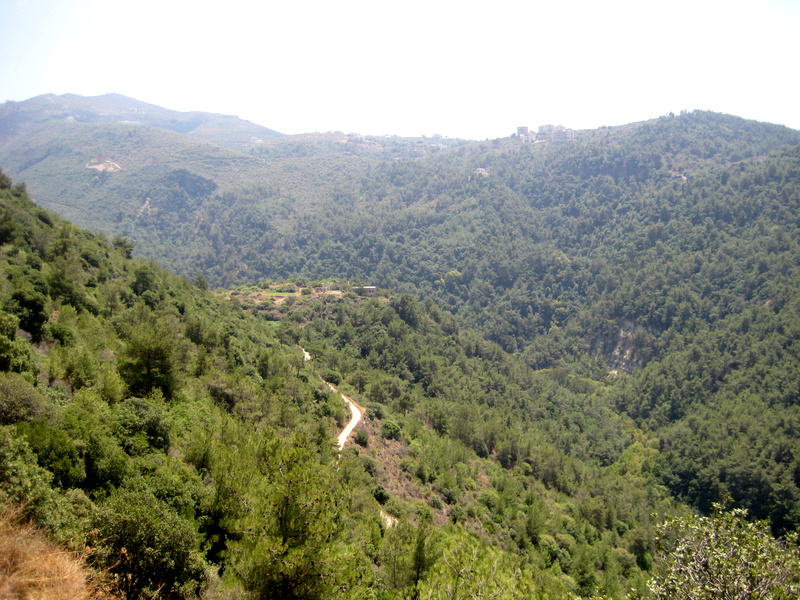
After 'Ain Baal, Semqaniyeh and Beqaata, it's really the Shouf as it used to be. Here's the view looking south. The last ridge is approximately our destination: Jezzine. Beyond that, the mountains grow smaller and it's probably no more than 20 miles or so as the crow flies to the beginning of the Galilee. Lebanon really is a tiny country:
| Sheer cliffs that have doubled for 1000s of years as terraces |
| In the wadi before the climb to Mukhtara |
The village of Mukhtara is the feudal seat of the Joumblatt family - which could also be spelled 'Jounblatt family', 'Junblat family', 'Jumblatt family', and so on. Like everybody else in Lebanon, the Druze used to be fiercely divided into factions. For several decades, since the time of Kamal Jounblatt, the Joumblatts have enjoyed a political ascendancy. The village is one of the best-preserved in the area. Here's the road up to the village from the wadi:
And here's a view of the village from the hillside opposite:
| Muhktara |
And, a view looking up at the Junblatt palace, much enlarged over the decades by Walid Junblatt, Kamal's son:
After Mukhtara, there's a series of small villages, as the countryside gets starker and more sharply defined. Here's a view looking back north at the relatively green and lush northern Shouf:
And now the wadi starts to deepen progressively into an enormous gorge:
At the same time, the lush green of the Shouf begins to recede as we approach Jezzine. At Jezzine the Shouf ends and the topography with it. Instead of the deep north-south crease of the Shouf, the area beyond it is more oriented east-to-west, with the valley of the Litani river cutting across it. This is a view looking back north from near Jezzine:
Now the last few kilometers, on a newly-asphalted road:
| What's wrong with this picture? Oh, yeah...a sheer cliff-edge for several kilometers and no guard rail! |
Finally, Jezzine! And a couple of views looking back north, really quite spectacular:
Subscribe to:
Posts (Atom)